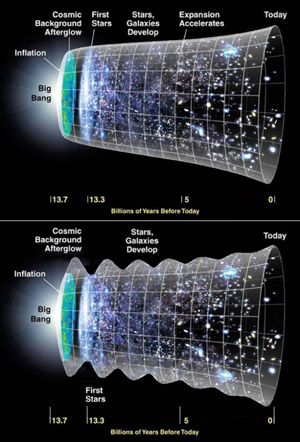
Seven Waves of Inflation have Rocked our Universe.

OscillatingUniverseThis is huge, pardon the pun, and very much under-reported. We have supplanted the idea that there was a sudden, huge inflation when the universe was born and then a flat, smooth curve with a slight increase in inflation rate recently.

A careful, new study of Type 1a supernova brightness–the universes’s standard candles–give a different picture. Yes, we still have a huge expansion soon after the big bang, but then the evidence is for seven waves of diminishing contraction and expansion thereafter (decreasing in size like the waves around a stone dropped into the water or the ringing of a bell). We are currently on one of the waves of expansion, which will peak and then slow into the next inflationary rate trough. The new model clears up a few anomalies in the old model, like the rate of early galaxy formation. Check it out at  Universe May be Ringing like a Crystal Glass

The diminishing waves of inflation suggest that one big event probably triggered them, with the forces of the universe seeking equilibrium thereafter. Perhaps our universe collided with another baby universe. Maybe it is still recovering from the force required for expulsion from a singularity. My bet is we have the answer soon.

Why doesn’t evolution eliminate mental illness?

I was reminded by a couple recent articles that mental illness, specifically psychosis and depression, must have significant survival value, or surely evolution would have rooted it out long ago. After all, these conditions often lead to risky behavior or suicide. Where’s the value in that?

The value is to the species, not to the individual. Male black widow spiders suffer from evolution’s ruthless disregard for the species at the expense of the individual, as do those who suffer from sickle cell anemia.

The articles that caught my eye were:

Tributes to the “Beautiful Mind” of John Nash,  such as this one by   Rachael Rettner at LiveScience.com  

which reminds us that psychosis, or “thinking outside the box”, has both good and bad sides.

The Nash tributes appears on the heels of a recent study Are Entrepreneurs “Touched by Fire” by Michael A Freedman

which highlights the (to me) more surprising association of depression with successful entrepreneurship. One mechanism that could explain this association is that depression results from or in an increased sensitivity to the needs of others, which entrepreneurs then proceed to do something about.

.

First day on the slush pile

I started a new adventure today as a slush pile reader for Flash Fiction Online by reviewing 9 stories. (Flash Fiction Online is a SFWA-approved, free electronic publication that offers a variety of stories of 1000 words or less–mostly speculative in nature.)

My job is to look at freshly-submitted stories and help decide if they will make the cut into the next round of serious consideration for an upcoming issue of FFO. My first reaction was OMG, how do I decide?

So I read all 9 stories beginning to end and examined how I responded to them. What I learned was that stories should not have any defects. Duh. We all know that stories should be well-written with interesting characters, a good pace and plot and satisfying ending. But the point is that any one defect is enough to cause a story to be rejected. A great beginning does not make up for boring writing. Great writing does not make up for a weak ending. And so forth. It doesn’t have to all be perfect, but nothing can be noticeably lacking.

This brings to mind the conventional wisdom (or myth, depending on your persuasion) that editors are looking for a reason to reject your work. This is more real to me now, but it also makes more sense. That one defect will not only turn off the editor, but it will turn off the reader, take them out of the story, and that is what must not happen.

In the end, I rated one story as good, two as maybe and the rest as rejects. Most of the rejects just didn’t have compelling writing. One was good all the way to the end, which then fell flat.

My initial goal with the slush pile project is to learn how to make my own writing better by understanding the editorial review process a little. So far, so good. Eventually I hope to see some great publications that I contributed to behind the scenes.

What I learned today about writing is that before you send out that story, don’t forget to reread it and look for the one thing that doesn’t seem quite right, but maybe nobody else will notice. They will notice. Fix it. The work will be worth it.

By the way, FFO uses an anonymous review process, so if you are a friend of mine, that is neither to your advantage or disadvantage. If you write flash fiction, Flash Fiction Online and I would love to see it.